
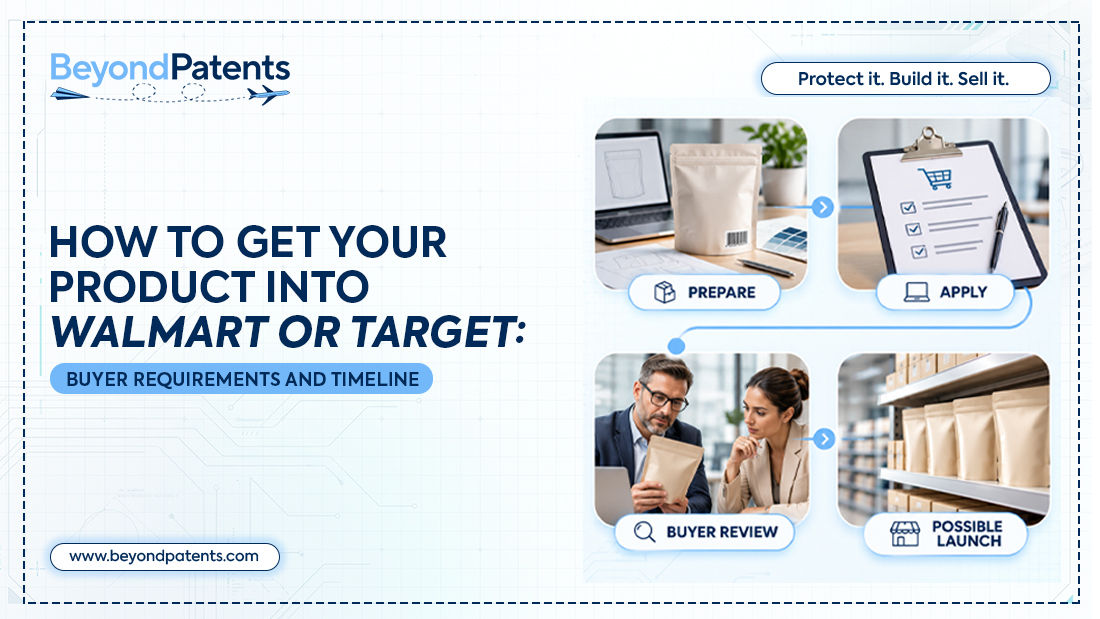
Getting a product into Walmart or Target requires the right retail route, a product that fits the retailer’s assortment, and preparation for the operational requirements that come with selling at a major retailer.
Both retailers have formal processes for businesses interested in selling products. Walmart directs U.S. businesses to its supplier application for consideration to sell products in stores or online. Target provides a Supplier Intake Form for businesses to submit company and product information.
The application is only one part of the process. A product also needs a clear commercial case, reliable supply capacity, accurate item information, and the documentation required for the retailer and product category.
Key Takeaways
- For store placement, pursue the retail supplier route, not a third-party marketplace.
- Start with Walmart’s supplier application or Target’s Supplier Intake Form.
- A submission does not guarantee a supplier agreement, buyer meeting, or store placement.
- Prepare product information, pricing, supply capacity, fulfillment details, packaging information, and applicable compliance documents before submitting.
- Separate recommended buyer materials from requirements the retailer actually publishes.
- Do not rely on a fixed application-to-shelf timeline. The process can involve several stages after the initial submission.
- Requirements can include insurance, testing, audits, product identifiers, packaging standards, EDI, and other operational setup depending on the retailer and product.
Which Route Gets a Product Into Walmart or Target Stores?
The first decision is whether the goal is to sell inventory to the retailer for resale or sell directly to shoppers through a third-party marketplace.
Walmart
Walmart’s supplier process covers businesses seeking to sell products through Walmart’s stores or online channels. Its supplier application page specifically separates the store, club, or online supplier path from Walmart Marketplace.
Walmart states that self-registration does not guarantee an agreement to do business. Walmart Marketplace is a separate channel for select third-party retailers selling on Walmart.com.
Marketplace products are identified as third-party items on the site.
Target
Target’s supplier process is the relevant route for businesses seeking to sell products at Target. Its public supplier materials also cover areas such as supplier standards, audits, product safety, insurance, EDI, and payment setup.
Target Plus is a separate third-party marketplace channel and should not be treated as equivalent to becoming a retail supplier.
Supplier vs. Marketplace Routes
| Route | Who sells to the customer? | Starting point | Does it establish store placement? |
|---|---|---|---|
| Walmart first-party supplier | Walmart resells the supplier’s product | Walmart supplier application | No guarantee of an agreement or placement |
| Walmart Marketplace | Third-party seller | Walmart Marketplace | No |
| Target retail supplier | Target resells the supplier’s product | Target Supplier Intake Form | No; Target reviews the submission |
| Target Plus | Third-party marketplace partner | Target Plus information | No |
The distinction matters because the application, commercial relationship, onboarding process, and operational requirements can differ.
Where Do We Submit a Product for Retail Consideration?
For Walmart, the starting point is the supplier application process. Walmart provides a supplier checklist covering information such as company details, tax information, product submissions, product and brand information, insurance, EDI, banking, logistics, and agreements.
For Target, the Supplier Intake Form asks businesses to submit company and product information for review.
Neither submission should be presented as an automatic route to a buyer meeting or store placement.
What Should Be Ready Before a Buyer Reviews the Product?
A strong retail submission needs more than a product description. The buyer needs enough information to understand the product, its place in the category, its commercial potential, and whether the business can support retail demand.
Show Category Fit and a Workable Commercial Offer
A buyer presentation or line sheet can include:
- Product category and target shopper
- Product differentiators
- Retail price
- Wholesale price or proposed commercial terms
- Sales and demand evidence
- Current distribution
- Manufacturing capacity
- Expected lead times
- Case-pack information
- Fulfillment capabilities
- Contact information
A case pack is the number of individual units packaged together for shipment or handling.
The goal is to make the commercial case easy to evaluate. Product quality alone does not answer questions about price, demand, margins, supply, or replenishment.
Compare Published Requirements Without Assuming the Lists are Identical
Walmart and Target do not publish identical supplier requirements. The safest approach is to use each retailer’s own published guidance rather than treating one retailer’s checklist as a universal standard.
| Topic | Walmart published guidance | Target reviewed public guidance |
|---|---|---|
| Business identification | Federal Taxpayer Identification Number for U.S.-based suppliers | Business and product information through the supplier intake process |
| Product identifiers | GS1 Company Prefix requirements apply | Requirements can vary by product and supplier setup |
| Insurance | Insurance requirements and proof of coverage | Certificate of insurance |
| Audits and testing | Applicable audits, certifications, inspections, and testing | Audit program, Standards of Vendor Engagement, and Product Safety & Quality Assurance |
| EDI | EDI-B2B setup and banking information during onboarding | EDI for purchase orders and EFT for payments |
| Packaging | Requirements covering packaging, labeling, palletizing, and shipping | Product-specific requirements may apply |
Walmart’s published supplier requirements specifically address tax identification, insurance, audits and testing, and packaging. Its onboarding checklist also includes EDI, banking, logistics, product information, and supplier agreements.
Target’s supplier materials identify areas including insurance, audits, vendor standards, product safety and quality, EDI, and EFT.
Understand Product Identifiers and EDI
A GTIN is a Global Trade Item Number used to uniquely identify a product. GS1 US explains that GTINs are the global standard for product identification and that a GS1 Company Prefix is used to create identification numbers such as GTINs.
EDI, or electronic data interchange, is the electronic exchange of business documents between organizations’ computer systems. Purchase orders and invoices are common examples.
These systems are part of the operational side of retail. They are different from the product pitch itself.
Prepare Item Data, Packaging, and Fulfillment Details
Once a product moves beyond the initial review, accurate product and logistics information becomes increasingly important.
Prepare the information that may be needed for item setup and supplier onboarding, including:
- Product name and description
- Product identifiers
- Product dimensions and weight
- Case quantity
- Product and packaging images
- Product category information
- Country or location of manufacture
- Shipping details
- Lead times
- Replenishment capabilities
- Facility information
- Relevant compliance documentation
Walmart’s onboarding checklist includes product and brand information, logistics, delivery details, lead times, facilities, insurance, EDI, and product catalog information.
Packaging also needs to be considered early. Walmart publishes separate packaging requirements covering areas such as labeling, palletizing, and shipping.
For Target, product-specific safety, quality, regulatory, and supplier requirements should be reviewed based on the product category and intended retail relationship.
Getting a product ready for a major retailer involves more work behind the scenes than a buyer sees at first glance.
What Is the Timeline From Application to a Possible Store Launch?
There is no universal published timeline from supplier application to store launch on the general Walmart and Target supplier pages reviewed.
The process is better treated as a series of stages:
Follow the Stages in Order
| Stage | What happens | Timing supported by reviewed sources |
|---|---|---|
| Preparation | Assemble product, commercial, and operational information | Brand-dependent; no general duration published |
| Submission | Use the appropriate supplier application or intake form | No guaranteed response duration published |
| Possible review or meeting | Retailer assesses fit and may request information | Not guaranteed; no general duration published |
| Agreement and compliance | Resolve terms and applicable supplier obligations | Depends on agreement and product |
| Item setup | Complete catalog and onboarding work | No general approval-to-shelf duration published |
| Possible launch | Begin selling if all relevant steps are completed | Not guaranteed |
| Walmart insurance upload | Upload certificate within 30 days after accepting the Supplier Agreement, per checklist | Document deadline, not time to shelf |
The exact sequence can vary by retailer, category, product, and supplier relationship.
For example, Walmart’s supplier checklist shows that onboarding can involve product submission, insurance, EDI, banking, facility setup, logistics, agreements, and other steps.
One Walmart requirement also illustrates why individual deadlines should not be confused with a total time-to-shelf estimate. The supplier checklist includes a deadline for completing certain insurance steps after the supplier agreement process.
That is an onboarding requirement, not a promise that a product will reach stores within that period.
Identify What Could Delay the Next Stage
Potential delays can come from:
- Incomplete supplier information
- Missing insurance or compliance documentation
- Product testing or certification requirements
- Packaging changes
- EDI or system setup
- Manufacturing capacity
- Inventory availability
- Retailer review and assortment decisions
What Should Be Budgeted Beyond the Application?
There is no universal Walmart or Target fee that guarantees shelf space. Costs depend on the product, category, supplier agreement, manufacturing setup, and fulfillment model.
A retail launch budget may need to account for:
- Manufacturing
- Packaging and labeling
- Product testing or certifications
- Insurance
- Audits, where applicable
- Photography and product content
- Freight and logistics
- Initial inventory
- Replenishment inventory
- Working capital
- Promotions or retail marketing
- Returns and other operating costs
Walmart’s published supplier requirements confirm that suppliers may need insurance and applicable audits, certifications, and testing.
The commercial terms should be modeled before pursuing the retailer. The product needs enough margin to support manufacturing, fulfillment, retailer economics, promotions, and ongoing replenishment.
FAQ
1. How to get your products in big box retailers?
The process starts with the retailer’s supplier or intake process. A small brand should have a clear product case, workable pricing, supply capacity, and the information required for supplier onboarding before submitting.
2. How do you get your products into retail stores?
Products generally need to be accepted into the retailer’s assortment and supported by a supplier relationship or other approved retail arrangement. Submitting a supplier application alone does not guarantee store placement.
3. How else can we get into stores aside from tracking down higher-ups?
Retailers provide formal supplier and intake processes. Walmart directs prospective suppliers to its application process, while Target provides a Supplier Intake Form. These are the appropriate starting points for formal consideration.
4. What are the costs to get into retail? Do you have to pay for shelf space and marketing?
There is no universal published fee that guarantees shelf space. Budgeting should focus on the costs required to make the product retail-ready and support inventory, fulfillment, compliance, and ongoing sales.
5. Are there certain requirements to be a supplier for Walmart?
Walmart publishes requirements covering areas such as tax identification, insurance, audits and testing, packaging, product information, EDI, banking, logistics, and supplier agreements.
6. What is the application and submission process for the 2026 Open Call?
Walmart runs an annual Open Call program for eligible products. The 2026 Open Call application window ran from July 9 through August 3, 2026, with product pitches submitted through RangeMe for the October event. Future applicants should check Walmart’s current Open Call information for updated dates and eligibility requirements.
Conclusion
Getting a product into Walmart or Target starts with choosing the right retail supplier route and preparing the product for review.
The basic sequence is:
Choose the route → prepare the product case → review requirements → submit → complete retailer onboarding → prepare for a possible launch.
An application starts the process. It does not guarantee a buyer meeting, supplier agreement, or store launch date.
The strongest submission is therefore supported by more than a good pitch. Examples of products that have moved through development, validation, and into retail can also help put the process in context.
Product information, pricing, supply capacity, documentation, packaging, and fulfillment should all be ready before moving forward.