
Key Takeaways
- A patent attorney or registered patent agent is the most direct route for patent preparation, filing, and USPTO prosecution.
- An invention company may help with product development, market research, manufacturing, promotion, or licensing, depending on the agreement.
- DIY filing gives an inventor more control over the process but also puts responsibility for the application, fees, deadlines, and USPTO correspondence on the inventor.
- A patent attorney, invention company, and DIY approach are not mutually exclusive. Different stages can use different types of support.
- USPTO fees are only part of the cost. Practitioner fees, prototypes, drawings, research, manufacturing, and commercialization can add substantially to the budget.
- No route can guarantee a granted patent, a licensing agreement, or commercial revenue.
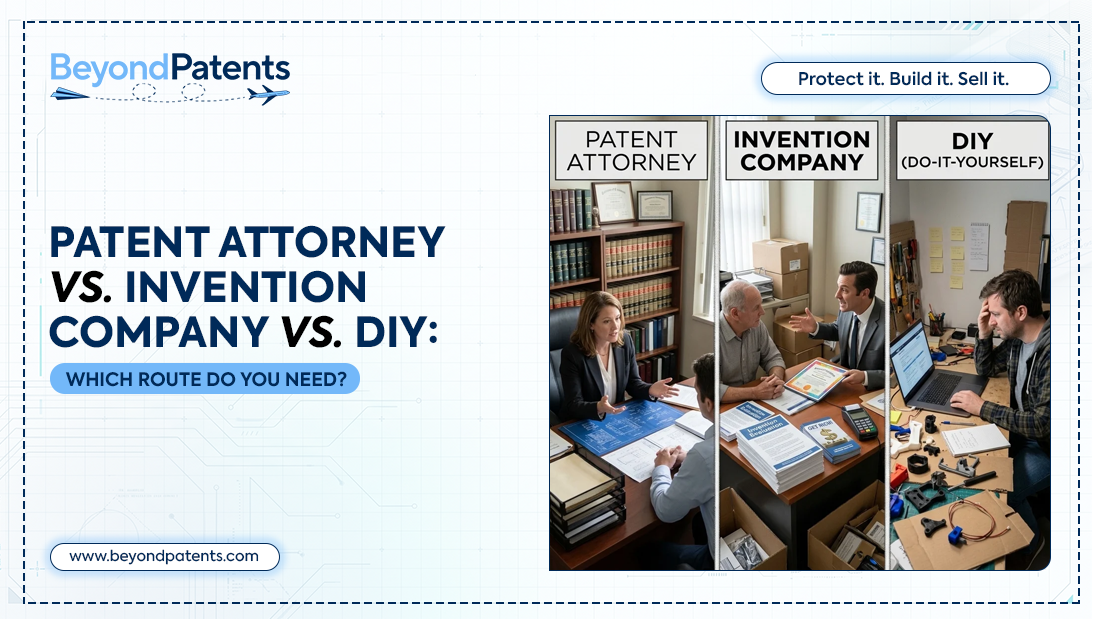
Choosing between a patent attorney, an invention company, and the DIY route depends on what the invention needs next.
For patent protection, a registered patent attorney or agent can prepare and pursue an application. An individual inventor can also file and pursue an application without representation.
For product development or commercialization, an invention company may provide market research, prototyping, promotion, or licensing outreach, depending on the agreement.
None of these routes guarantees a patent, licensing deal, or revenue.
The Quick Comparison: Match the Route to the Goal
| Patent Attorney or Agent | Invention Company | DIY | |
|---|---|---|---|
| Primary role | Patent protection and USPTO prosecution | Product development and commercialization support | Filing and managing the process independently |
| Cost | Professional fees + USPTO fees | Service fees vary by scope + other project costs | Lowest professional cost, but USPTO fees still apply |
| Effort | Lower day-to-day burden | Depends on the services purchased | Highest inventor involvement |
| Legal security | Professional patent guidance | Depends on whether qualified patent counsel is involved | Inventor handles the legal and procedural work |
| Commercial viability | Primarily focused on protection | Can include validation, manufacturing, sales, or licensing support | Inventor must handle commercialization or hire separate help |
| Best fit | Filing and protecting an invention | Moving a product toward market | Inventors comfortable managing the patent process |
These routes can also be combined. For example, an inventor could use a patent practitioner for filing while handling market research independently.
What Each Route Actually Delivers
Patent Attorney or Registered Patent Agent
A patent practitioner can help with:
- Reviewing prior art and the invention’s patentability
- Preparing the technical disclosure
- Drafting patent claims
- Preparing and filing the application
- Responding to USPTO Office actions
- Managing prosecution through the application process
Both registered patent attorneys and registered patent agents can represent applicants before the USPTO in patent matters. A patent agent is not an attorney, while a patent attorney is also a lawyer. The USPTO maintains a register of practitioners authorized to represent patent applicants.
Hiring a patent practitioner does not guarantee that the USPTO will grant a patent.
Invention Company
Depending on the agreement, an invention company may provide:
- Prototype development
- Market research
- Product design
- Manufacturer introductions
- Marketing or promotion
- Licensing outreach
- Launch and distribution support
If patent work is included, ask:
- Who will prepare the application?
- Is that person a registered patent practitioner?
- What patent services are included?
- What does the quoted fee cover?
- Who owns the resulting application, research, designs, or other deliverables?
A marketing task or manufacturer introduction should not be treated as a signed licensing agreement or actual sales.
BeyondPatents connects inventors with patent attorneys and offers separate support for development, market validation, launch, and distribution.
DIY Filing
DIY patent filing means the inventor handles the application process without appointing a patent attorney or agent.
The inventor is responsible for:
- Preparing an adequate disclosure
- Drafting claims where required
- Selecting the appropriate application type
- Paying USPTO fees
- Tracking deadlines
- Responding to USPTO correspondence
- Managing the application through examination
The USPTO allows an eligible individual applicant to file and prosecute an application pro se. The agency also notes that patent preparation and prosecution require knowledge of patent law, USPTO rules, procedures, and the technical subject matter of the invention.
There is an important distinction for companies. A juristic entity, such as a corporation, must be represented by a registered patent practitioner.
Applicants whose domicile is outside the United States or its territories have also been required to use a USPTO-registered patent practitioner for patent matters since July 20, 2026.
The USPTO’s Pro Se Assistance Center provides education and filing assistance, but its staff cannot provide legal advice.
Compare the Total Cost, Not the Advertised Starting Price
Patent costs can include:
- USPTO filing, search, and examination fees
- Patent practitioner fees
- Patent drawings
- Prior-art research
- Office action responses
- Additional claims or filings
- Prototypes and testing
- Product development
- Market research
- Manufacturing
- Licensing or sales work
The USPTO’s current fee schedule lists a $325 provisional filing fee for a standard entity and $65 for a qualifying micro entity. See the current USPTO fee schedule.
For a standard electronically filed nonprovisional utility application, the current USPTO fees are:
- Basic filing fee: $350
- Utility search fee: $770
- Utility examination fee: $880
- Combined total: $2,000
For a qualifying micro entity, those three fees total $400. Other fees can apply, including fees for additional claims, excess pages, non-DOCX filings, extensions, and later stages of the patent process.
These are USPTO government fees, not all-in patent costs. A practitioner may charge separately for preparing the application, responding to Office actions, and handling other work.
A low initial quote may cover only the first filing while leaving later work outside the package.
Check the Fine Print Before Paying Anyone
Check the Patent Professional
Search the USPTO’s registered patent practitioner directory before hiring a patent attorney or agent.
Review Invention Promoter Disclosures
Covered invention promoters have specific pre-contract disclosure requirements under 35 U.S.C. § 297.
Before entering a contract for invention promotion services, the promoter must provide information including the number of inventions evaluated over the previous five years, positive and negative evaluations, customers who contracted for covered services, and customers known to have received a net financial profit directly from the services.
The statute also requires information about customers known to have obtained licensing agreements as a direct result of the promoter’s services.
A required disclosure can show what the company reports about its outcomes. It does not mean every reported result has been independently verified.
Get the Deliverables in Writing
The agreement should cover:
- What work will be performed
- Who will perform it
- What is included in the price
- What costs are additional
- When each deliverable is due
- What happens if the project ends early
- Who owns the work and intellectual property
Before sharing an invention with potential partners or investors, it’s worth considering how to protect the idea and clarify ownership.
Be especially careful with guarantees of patent approval, licensing, sales, or profits.
Understand What a Provisional Application Does and Does Not Do
A provisional application can establish an early U.S. filing date and allow an inventor to use “Patent Pending” in connection with the invention.
A provisional does not require formal patent claims, an oath or declaration, or an information disclosure statement. Most importantly, it is not examined on its merits.
A provisional application has a 12-month pendency period. To claim its benefit in a later nonprovisional application, the nonprovisional generally needs to be filed during that period. The later application receives the earlier filing date only for subject matter that was adequately disclosed in the provisional.
A rushed provisional that leaves out important aspects of the invention may not provide the expected priority for those later-added details.
For a broader explanation of the filing process, see BeyondPatents’ How to Patent an Idea: A Step-by-Step Guide for First-Time Inventors.
Which Route Makes Sense?
- Patent attorney or agent: When patent protection is the immediate priority.
- Invention company: When development, validation, manufacturing, distribution, or licensing support is needed.
- DIY: When an eligible inventor is prepared to manage the filing and USPTO process independently.
The routes can also be combined. An inventor might use a patent practitioner for filing and separate support for product development or market validation.
BeyondPatents also separates patent services from commercialization support, including Market Validation and Launch & Distribution.
FAQ
1. Can I use a DIY patent-filing product instead of hiring an attorney?
A patent-filing tool may help organize a DIY filing, but it does not replace advice from a registered patent practitioner.
For inventors who need assistance but cannot afford full professional representation, the USPTO also operates a Pro Se Assistance Center and a Patent Pro Bono Program. Eligibility requirements vary.
2. Is a patent agent different from a patent attorney?
Yes. Both can be registered to represent applicants in patent matters before the USPTO. A patent agent is not an attorney, while a patent attorney is a lawyer who is also registered to practice before the USPTO.
Check the USPTO’s practitioner directory before hiring either professional.
3. Can an invention company patent my idea?
An invention company may coordinate patent services, but the agreement should make clear who will prepare and prosecute the application.
If patent work is included, ask for the registered practitioner’s name, scope of work, fees, and ownership terms in writing.
4. Is a provisional application the same as a patent?
No. A provisional application is not examined and does not itself become a patent. It can establish an early filing date and support patent-pending status for 12 months.
A corresponding nonprovisional generally must be filed during that period to claim its benefit.
5. How can I check whether an invention company has helped customers make money?
Start with its required written pre-contract disclosures if the company qualifies as a covered invention promoter. The disclosures include figures for customers known to have earned a net financial profit or obtained licensing agreements directly through the promoter’s services.
Then ask what those figures actually count. A customer testimonial, manufacturer introduction, and signed license are very different outcomes.
6. Who owns my invention and application if I sign a service agreement?
Do not assume. Review the agreement’s ownership, assignment, and licensing provisions before signing. Check who owns the patent application, prototypes, research, designs, and other work created during the project.
If the agreement transfers patent rights or grants another party a license, consider having a qualified professional review the terms before signing.
The Bottom Line
Before choosing a route, define the immediate goal: patent protection, product development, commercialization, or a combination. Then compare the written scope, total costs, deliverables, and ownership terms before committing.
BeyondPatents takes a modular approach to the invention process, with support across patent services, development, market validation, launch, and growth.